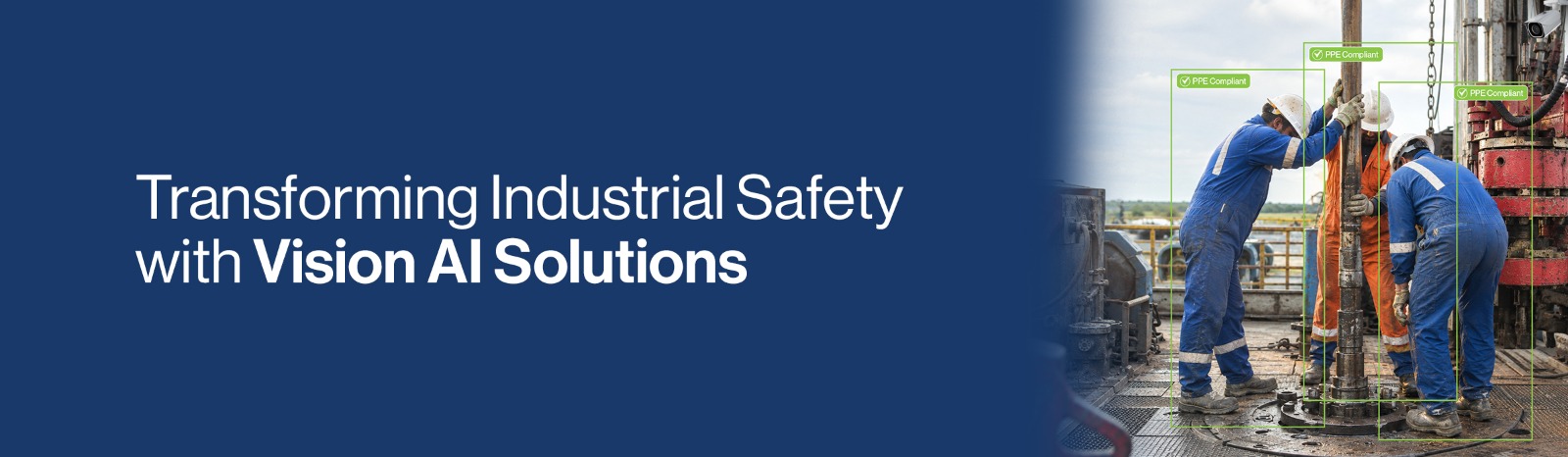
Industrial Safety Automation: How Vision AI Improve Workplace Safety
What Is Industrial Safety Automation?
Industrial automation in safety refers to the use of technology, including robotics, sensors, and Vision AI-powered monitoring systems, to perform safety-critical functions without continuous human intervention.
Where traditional safety management depends on periodic human observation and manual reporting, this approach creates a continuous, systematic layer of oversight that operates independently of shift patterns, supervisory presence, or individual attentiveness.
The first generation of industrial automation in safety focused on physical risk reduction: replacing human workers in hazardous tasks, installing machine guards, and automating processes that carried high injury risk through direct contact with machinery or materials.
The current generation goes further. Vision AI in industrial safety, and specifically Vision AI, applies intelligence to the monitoring and compliance layer, not just the operational one.
Rather than simply removing workers from hazardous tasks, it continuously monitors whether workers in those environments are adhering to the safety protocols designed to protect them, detecting violations as they occur and alerting supervisors in real time.
The Disrupt Labs operates at this layer. By applying computer vision to existing CCTV infrastructure, the platform converts passive video recording into an active, automated safety monitoring system that operates 24 hours a day across every monitored zone.
Signs Your Workplace Needs Safety Automation
Frequent Safety Violations
Recurring PPE violations, repeated access of restricted zones, and persistent housekeeping failures are the most reliable indicators that a manual monitoring model is not matching the scale or pace of operations. These are not typically signs of a workforce that is indifferent to safety; they are signs of a compliance model that cannot maintain consistent coverage. When violations are most frequent during off-peak hours, overnight shifts, or in zones farthest from supervisory positions, the pattern indicates a structural monitoring gap rather than a personnel problem.
High-Risk Manual Processes
Facilities where workers regularly operate in close proximity to heavy vehicles, handle hazardous materials, work at height, or operate machinery with significant energy or pressure risks carry an elevated incident profile that periodic walkthroughs cannot adequately address.
The National Institute of Occupational Safety & Health (NIOSH) conducted a survey in 2022, which returned data of 106,000 nonfatal illnesses and injuries associated with contact with objects and 5846 fatalities due to contact injuries.
These are precisely the environments where workplace safety automation delivers the most immediate and measurable impact.
Limited Visibility Across Operations
When safety managers cannot answer basic operational questions, such as what the PPE compliance rate was during last night’s shift, or whether any restricted zones were accessed over the weekend, the facility lacks the data infrastructure that effective safety management requires.
Visibility gaps this significant indicate that monitoring is happening at intervals rather than continuously, and that the data being generated is not structured or accessible enough to inform decisions.
Delayed Safety Response
If the typical timeline between a hazard developing and the appropriate corrective action being taken is measured in hours or days rather than minutes, the detection and alerting mechanisms are not functioning effectively.
Delayed response is both a symptom of inadequate monitoring and a direct multiplier of incident risk.
Building an Automated Safety Strategy
Identifying Critical Risk Areas
The starting point for any effective safety automation deployment is a risk-prioritized review of the facility. Not every zone carries the same consequence profile.
Vehicle-pedestrian interaction zones, chemical storage areas, elevated work platforms, and high-throughput production lines carry higher consequence risk than lower-hazard areas and should be prioritized for initial monitoring coverage.
The Disrupt Labs works through this by providing a tailored solution for each facility.
Automating Safety Monitoring
Once critical risk areas are identified, the monitoring function is automated through Vision AI applied to the existing camera infrastructure covering those zones. Industrial automation in safety at this level means that PPE compliance, restricted zone access, unsafe behaviors, and housekeeping conditions are monitored continuously rather than observed periodically. The human role shifts from observation to response: supervisors act on alerts rather than conducting walkthroughs to generate them.
Standardizing EHS Compliance
Automated safety systems enforce the same compliance standard across every shift, every zone, and every worker, removing the variability that comes with human-led enforcement.
A standard that applies consistently regardless of who is on shift and what time of day it is is a fundamentally different compliance model from one where enforcement depends on supervisory presence.
At The Disrupt Labs, we provide the Vision AI solution for industrial automation. Our smart CCTV vision system is designed to directly notify centralized dashboards; it targets specific friction points like PPE compliance audits, and updates the company’s data as they go along, not having to wait for monthly or quarterly audits and reviews.
Our AI-powered solutions enhance Environmental Health and Safety (EHS) management by enabling real-time hazard detection, compliance monitoring, and proactive risk prevention across industrial environments.
Creating Continuous Safety Oversight
The transition from periodic to continuous oversight is the core operational shift that workplace safety automation enables.
Rather than a scheduled inspection that produces a point-in-time record, industrial automation in safety generates a continuous dataset of compliance events, near-misses, and violation patterns across all monitored zones.
This is the data foundation that makes both proactive safety management and meaningful EHS compliance reporting possible.
Turning Existing CCTV into an Automated Safety Network
One of the most practically significant aspects of The Disrupt Labs’ approach is that it does not require replacing existing camera infrastructure.
The platform is a software layer applied to existing IP camera feeds, converting a passive recording network into an active, intelligent safety monitoring system. This retrofit model dramatically reduces the cost and disruption of implementation.
Continuous Workplace Monitoring
The cameras already covering a facility’s operational zones become the eagle eye view for continuous safety monitoring by safety supervisors.
Unlike a human observer who can watch one area at one time and whose attention degrades with fatigue, the Vision AI system analyzes every camera feed simultaneously and continuously, applying the same detection criteria to every frame regardless of shift timing.
Intelligent Event Detection
The Disrupt Labs’ computer vision solutions are tailored to your facility, which is what enables reliable detection in actual factory conditions. The system distinguishes between a worker correctly wearing a high-visibility vest and one wearing a similarly colored garment that does not meet PPE requirements. It identifies a worker stationary in a forklift travel path versus one simply passing through the zone.
Automated Safety Notifications
When a risk condition is detected, an alert is delivered immediately to the relevant supervisor through The Disrupt Labs’ centralized dashboard and SafetyLens mobile application. The alert includes zone, timestamp, and violation type, giving the supervisor the specific information needed to respond effectively rather than a generic notification that requires further investigation. Near-miss events are logged automatically alongside confirmed violations, building a structured dataset of developing risk patterns.
Centralized Safety Intelligence
The data generated across all monitored zones and shifts is consolidated in a centralized dashboard, giving safety managers a real-time picture of compliance status across the entire facility. Real-time CCTV analytics aggregate detection data into structured insights: compliance rates by zone, violation frequency by shift, and trend analysis across time periods. This is the foundation for the shift from reactive incident management to proactive risk prevention.
Measuring Safety Performance Through Automation
Tracking Compliance Trends
Industrial automation in safety generates the data infrastructure needed to track compliance trends meaningfully. Rather than relying on periodic audit snapshots, safety managers can access violation frequency by zone, shift, and workflow type on a continuous basis. A zone that consistently generates PPE violations during the last two hours of the evening shift points to a specific structural factor, whether fatigue, lighting, or workflow design, that can be addressed systematically rather than managed event by event.
This is the practical difference between lagging indicators and leading ones. Incident reports tell you what already happened. Continuous compliance data tells you where risk is currently accumulating and in which direction it is moving. A facility that can see a rising near-miss frequency in a specific zone across successive shifts has enough information to intervene before an incident occurs. One that waits for the next scheduled audit does not.
This is also what changes the nature of the safety audit itself. When continuous data is available, a scheduled audit stops being a discovery exercise and becomes a verification one. The auditor arrives with a data-backed picture of where violations have been concentrated, which zones carry the highest risk profile, and which corrective actions from previous reviews have produced measurable compliance improvement. The audit becomes more targeted, more productive, and more defensible to external reviewers than one conducted from a blank checklist.
Identifying High-Risk Zones
Traditional CCTV infrastructure records what happens. AI-powered CCTV interprets it. The Disrupt Labs applies computer vision models to live camera feeds, converting passive surveillance networks into active, real-time monitoring systems that analyze every frame across every monitored zone simultaneously. Rather than footage being reviewed after an incident, the system identifies developing risk conditions as they occur and delivers an alert to the relevant supervisor within seconds.
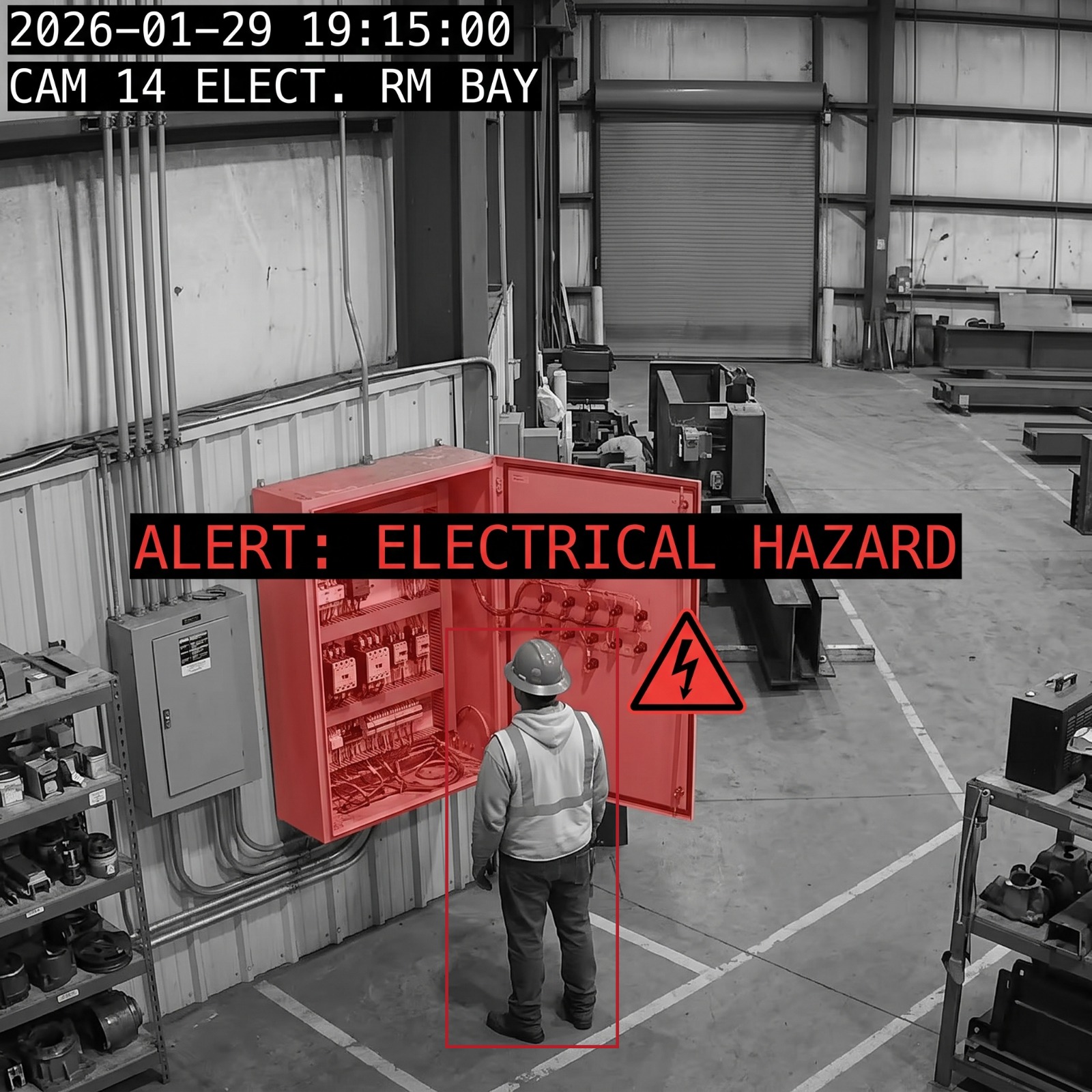
This real-time capability is what makes the shift from reactive to proactive safety management operationally meaningful rather than aspirational. A supervisor who receives an alert the moment a worker enters a high-voltage area without authorization can intervene before contact with a hazard. A supervisor reviewing end-of-shift footage cannot. The difference is not a matter of technological sophistication; it is a matter of response timing, and response timing is what determines whether a developing situation is corrected or becomes a recordable incident.
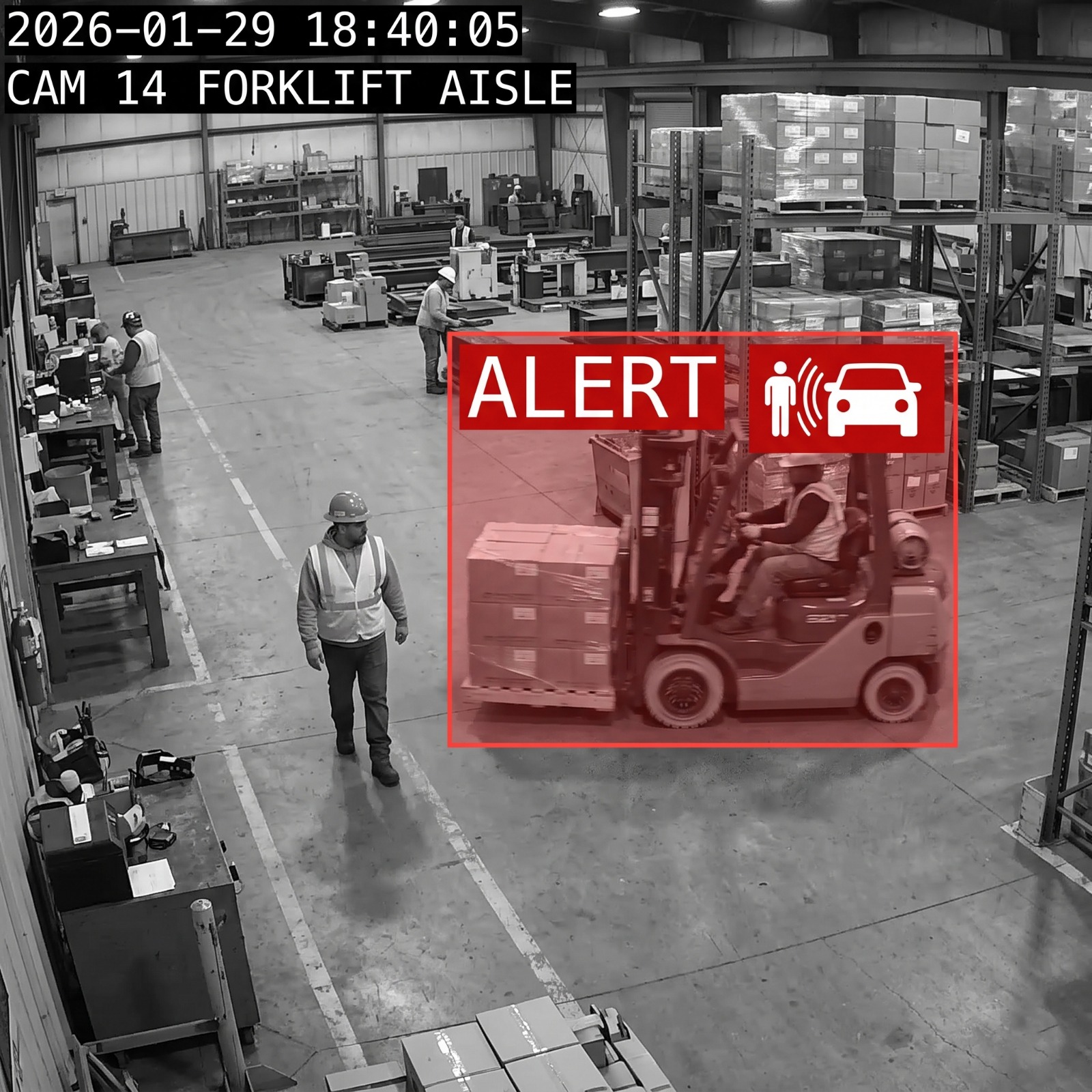
The volume of detection data generated across continuous monitoring also creates an analytical layer that periodic inspection cannot produce. The continuous dataset makes high-risk zones visible through pattern analysis rather than through incident reporting. A corridor that regularly generates near-miss alerts between forklifts and pedestrians during shift changeover periods is identifiable as a high-risk zone before a contact incident occurs. Restricted zone monitoring data makes unauthorized access patterns visible across shifts and time periods, identifying which zones and which periods carry the highest access risk.
Improving Incident Response
The time between a hazard developing and the right person being notified is one of the most operationally significant variables in industrial safety. Industrial automation in safety through Vision AI compresses that timeline from minutes or hours to seconds, which is the window in which intervention is still possible before a developing situation escalates.
Industrial automation in safety generates the data infrastructure needed to track compliance trends meaningfully. Rather than relying on periodic audit snapshots, safety managers can access violation frequency by zone, shift, and workflow type on a continuous basis. A zone that consistently generates PPE violations during the last two hours of the evening shift points to a specific structural factor, whether fatigue, lighting, or workflow design, that can be addressed systematically rather than managed event by event.
This is the practical difference between lagging indicators and leading ones. Incident reports tell you what already happened. Continuous compliance data tells you where risk is currently accumulating and in which direction it is moving. A facility that can see a rising near-miss frequency in a specific zone across successive shifts has enough information to intervene before an incident occurs. One that waits for the next scheduled audit does not.
Supporting Audit Readiness
Every detection event is automatically timestamped and logged by zone and violation type. This generates a continuous compliance record that supports safety audits and regulatory reporting without additional manual preparation. Rather than compiling an audit trail retrospectively from inspection logs and incident reports, the facility has a complete, objective record of every flagged event across all monitored zones and all shifts, available on demand.
The Disrupt Labs’ platform surfaces this data through a centralized dashboard that aggregates detection events across all monitored zones in real time. PPE compliance rates, restricted zone access patterns, housekeeping violations, and near-miss frequency are all visible as a live operational picture rather than a retrospective report. Safety managers are no longer working from what happened last week; they are working from what is happening right now, and from the patterns that have been building across the past several shifts.
Why The Disrupt Labs for Industrial Safety Automation?
Vision AI for Industrial Operations
The Disrupt Labs’ platform is built specifically for industrial environments rather than adapted from general-purpose computer vision solutions. AI powered CCTV solutions analyze live video input, which is what enables reliable detection in the conditions that actually exist on a factory floor. This is the beauty of a tailored solution.
A PPE detection model trained on clean, well-lit demonstration footage will generate false positives and missed detections in a Pakistani textile mill or a petrochemical plant at 2:00 AM. That is not a deployment failure; it is a training data mismatch.
Consider a busy warehouse during a peak shift. Workers are moving quickly, forklifts are navigating between racking aisles, and a loading zone is being accessed repeatedly as deliveries come in. In that environment, a supervisor cannot realistically track every entry point simultaneously. A Vision AI system can.
The moment a worker enters a loading zone without the required PPE, whether that is a missing helmet, an absent high-visibility vest, or unprotected footwear, the system identifies the violation and pushes an alert to the safety dashboard within seconds. The supervisor does not need to be watching that camera feed. The system is watching it continuously, and the alert arrives while the worker is still in the zone and correction is still possible.
This is what consistent safety protocol enforcement actually looks like in practice. It is not dependent on whether a supervisor happened to be nearby or whether the shift in question was a day shift with higher staffing levels.
Safety managers move from responding to incidents to preventing them, and the facility accumulates a structured, timestamped record of every intervention along the way.
AI-Powered EHS Compliance
Compliance documentation generated by manual inspection is inherently selective: it records what was observed during the inspection window by a specific observer. The continuous compliance record generated by The Disrupt Labs’ platform is objective, comprehensive, and available for review at any time without additional preparation. For EHS management teams that carry the burden of regulatory reporting and external audit preparation, this shift from manual compilation to automated documentation is a material operational improvement.
Scalable Safety Monitoring
For enterprise operations with multiple sites, this automation layer through a centralized platform makes cross-site benchmarking and consistent compliance standards achievable in a way that site-by-site manual monitoring cannot. Every facility generates data in the same format, enabling genuine comparison of compliance rates, incident frequencies, and violation patterns across locations. The same platform that monitors a single production line scales to cover an entire multi-site manufacturing network without architectural change.
Actionable Safety Analytics
The Disrupt Labs’ dashboard gives safety managers access to the analytics that turn detection data into operational decisions. Which zones are generating the most violations? Which shifts carry the highest non-compliance rates? Where are near-miss patterns concentrating? This is the difference between a safety monitoring system that records what happened and one that tells safety managers what to do about it. For a broader view of how this connects to AI for EHS management, the operational integration is covered in more detail there.
The Future of Industrial Safety Automation
The trajectory of AI in industrial safety is toward greater predictive capability. The current generation of systems detects hazards as they occur. The next generation will identify the conditions that consistently precede them, enabling intervention at the level of the underlying risk factor rather than the individual event.
As The Disrupt Labs collects data from the floor, the system starts connecting the dots on recurring issues. It highlights the trouble spots—like a blind corner where near-misses keep happening, a shift change where PPE compliance always drops, or peak hours when safety rules get overlooked. Catching these patterns early lets teams fix the root cause before an accident happens, shifting safety from a reactive check to true prevention.
The integration of Vision AI with broader occupational health and safety frameworks, including workforce health monitoring and ergonomic risk detection, represents the next major expansion. Facilities building this robust data infrastructure today are best positioned to leverage upcoming capabilities in ergonomic risk detection and predictive analytics.
Ultimately, workplace safety AI and AI safety monitoring are converging with quality control and operational intelligence. By utilizing a Vision AI based solution that is widely applicable but tailored to a facility’s needs e.g. safety compliance, risk mitigation and monitoring, The Disrupt Labs is pioneering this unified ecosystem to deliver end-to-end operational visibility.
Conclusion
Industrial automation in safety is no longer a direction that high-risk industries are moving toward. It is an operational capability already deployed and delivering documented outcomes in manufacturing, petrochemicals, FMCG, and warehousing environments. The Disrupt Labs converts existing camera infrastructure into a continuous, intelligent safety monitoring network with no hardware replacement required, generating the detection data, compliance records, and trend analytics that move safety management from reactive to proactive.
The gap between having cameras and having a safety intelligence platform is the gap between recording incidents and preventing them.
Contact The Disrupt Labs to discuss how industrial safety automation can strengthen protection and compliance in your facility.
Frequently Asked Questions
Using artificial intelligence for Environmental, Health, and Safety (EHS) management enhances workplace safety by shifting organizations from reactive responses to proactive risk prevention.
Hazard recognition is crucial because it is the foundational first step in preventing workplace injuries, illnesses, and fatalities. By spotting and fixing unsafe conditions or behaviors early, organizations stop minor issues from turning into major accidents.
Continuous monitoring supports risk prevention by using AI-powered CCTVs to collect and analyze real-time data. This constant oversight replaces slow periodic checks with live tracking, allowing teams to spot small system flaws, policy breaks, or safety issues and fix them before they turn into major problems.
When a system detects a violation, it typically logs the event, triggers an automated response (such as blocking the action or flagging a user), and sends a real-time alert to administrators or security teams for review and enforcement

Wafa Zehra
She brings together her expertise in business development and content strategy to showcase the growing role of computer vision AI in enhancing workplace safety and HSE/EHS compliance. At The Disrupt Labs, she focuses on writing insightful content that explores AI-driven innovations and their impact on industrial safety.
View all posts