What are the AI solutions for Workplace Safety
What Are AI Solutions for Workplace Safety
Industrial facilities generate a huge volume of visual data every single day. Cameras record footage across multiple zones, each different from the last, e.g. production floors, loading docks, and chemical storage areas, etc. In most facilities, however, the vast majority of that footage is never reviewed until after something goes wrong. That is the fundamental problem that The Disrupt Labs Vision AI solutions for workplace safety are designed to solve. AI solutions for workplace safety use computer vision, machine learning, and real-time analytics to provide continuous monitoring of workplace environments
This blog covers what these systems actually are, how they use video analytics for workplace safety, and where they deliver the most measurable value across industrial operations.
How Video Analytics Improves Safety Monitoring
The most accurate way to understand our Vision AI solutions for workplace safety is to think of them not as cameras, but as intelligent software layers that sit on top of existing video infrastructure. The cameras themselves are largely unchanged. What changes is what the system does with the live video feed.
Where a standard CCTV setup records footage passively, a Vision AI system interprets it in real time. Trained on large datasets of industrial footage, the models are custom built to recognize specific objects, behaviors, and spatial relationships of your industrial facility’s layout.
When the system identifies a condition that meets a predefined risk threshold, it generates an alert and delivers it immediately to the relevant safety supervisor. The passive recording infrastructure becomes an active, automated safety supervisor that operates continuously across every shift, every zone, and every day of the week.
This is what distinguishes AI-powered CCTV from conventional surveillance: not the hardware, but the layer of intelligence that turns stored video data into actionable, real-time safety intelligence.
Real-Time Compliance Monitoring Using Vision AI
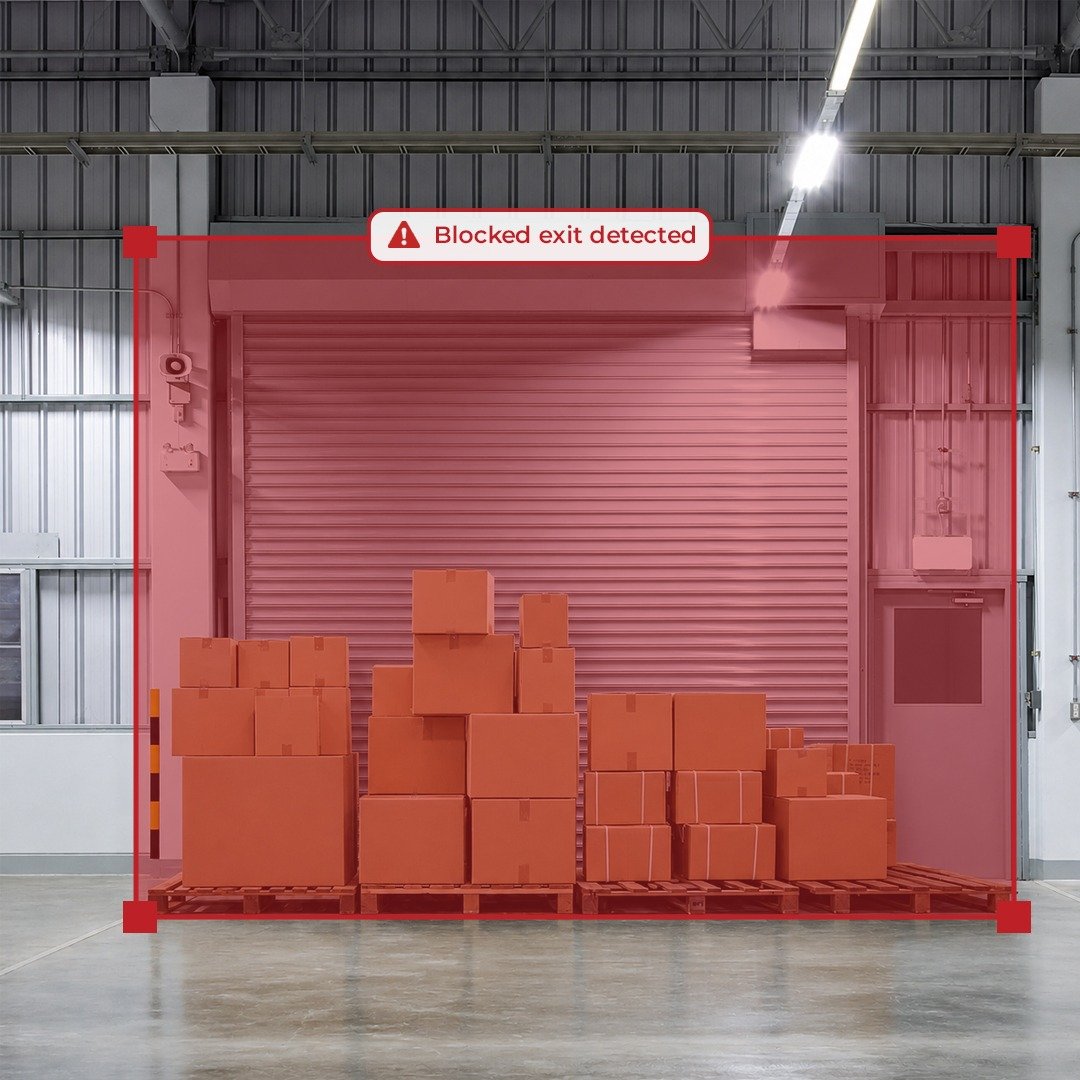
One of the most operationally significant applications of real time compliance monitoring with Vision AI is restricted area control, and housekeeping (keeping walkways clear of hazards like oil spills, or blocked exits, etc.). Rather than relying on physical barriers or manual enforcement to keep workers out of hazardous areas, the system monitors defined virtual perimeters within the video feed and sends alerts immediately when those boundaries are crossed by an unauthorized individual.
This capability extends across several compliance categories. Restricted zone entry is the most straightforward: a worker entering a heavy machinery area without PPE or a chemical handling zone without authorization triggers an immediate alert.
However, the system also monitors for other behavioral anomalies: workers in vehicle travel paths, personnel remaining in confined spaces beyond a defined duration (e.g. in loud and noisy machine areas that can affect them adversely), etc., in ways that would be difficult to detect without continuous visual coverage.
Detection of PPE Violations with Video Analytics
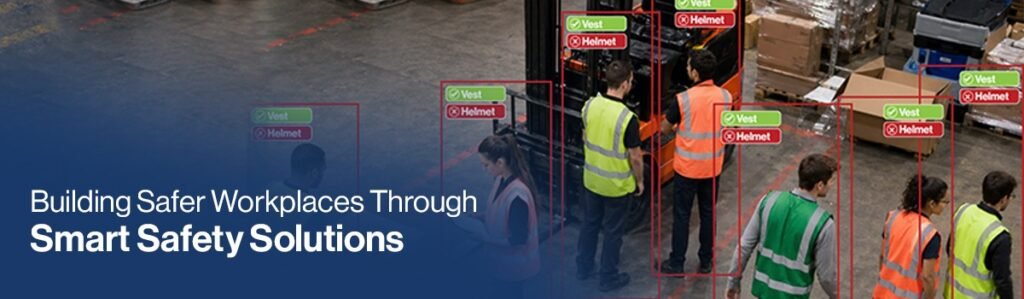
Detection of PPE with video analytics is technically less demanding than zone or perimeter monitoring, and it is worth being specific about why. The challenge is verifying correct PPE usage on a moving worker in a real industrial environment, which is why The Disrupt Labs Vision AI solutions for workplace safety are trained on real industrial footage.
The non-adversarial nature of automated enforcement is also worth noting here. Manual PPE enforcement can generate friction between workers and management, particularly when it is applied inconsistently across shifts or supervisors. Automated detection applies the same standard to every worker regardless of who is on shift
AI Forklift CCTV Solutions and Accident Prevention
Forklift-related incidents account for a disproportionately high share of serious injuries in warehouse and manufacturing environments. The root cause in most cases is not equipment failure but proximity: a forklift and a pedestrian occupying the same space at the wrong time, often because neither party had adequate visibility of the other.
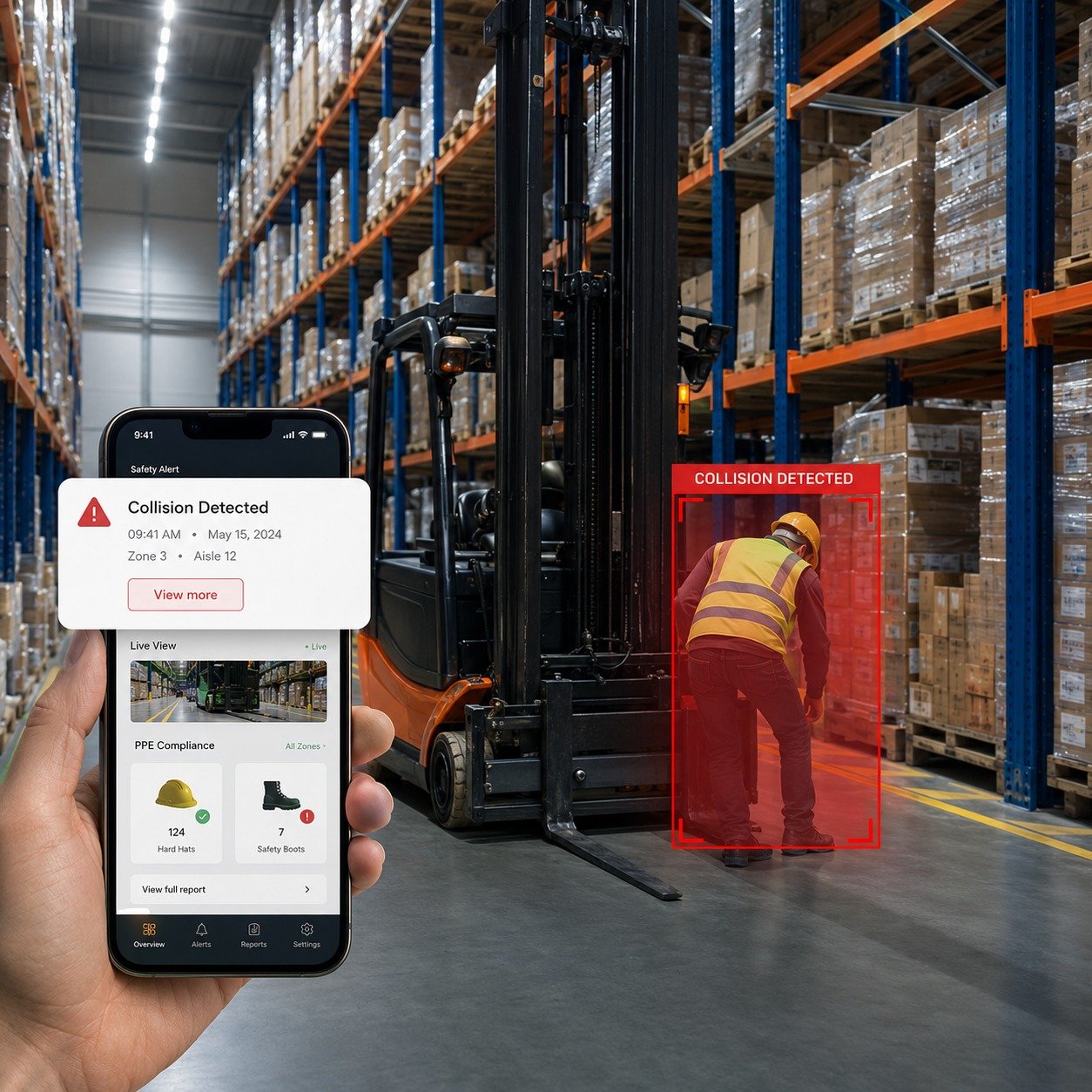
Vision AI solutions for workplace safety with forklifts address this through proximity detection, which is meaningfully different from simple motion detection.
This predictive capability is what makes it more operationally valuable than a camera that records the incident after it has happened. For high-traffic facilities with complex internal traffic patterns, this layer of automated proximity monitoring significantly reduces the cognitive burden on operators who are managing multiple zones or a large fleet simultaneously.
Managing Height-Related Risks Using Computer Vision
Working at height remains one of the highest-consequence risk categories in industrial safety, and it is also one of the areas where AI solutions for workplace safety has the most significant coverage limitations.
Computer vision technology for height-related risks is a subset of AI Solutions for workplace safety, and it operates across several specific detection scenarios. Harness detection on elevated workers verifies that a harness is present. Automated detection of these conditions removes the reliance on manual floor inspections to identify non compliance.
Key Benefits of AI-Driven Workplace Safety Systems
The most significant benefit is in how the accumulated data gets used. Detection is the entry point. The longer-term value of Vision AI lies in the ability to generate real time alerts. These can be used further to identify patterns across thousands of flagged events and draw structural conclusions about where and why risk is concentrated in a facility.
To make a point here, Vision AI is a gold-mine for EHS teams looking to optimize industrial automation.
There are other benefits too, for example:
- Objective auditing: Traditional safety audits rely on periodic manual inspections which are inherently selective. Automated monitoring generates a continuous, timestamped digital record of every flagged event across all monitored zones. This creates an audit trail that is objective and complete rather than dependent on what happened to be observed during a scheduled walkthrough.
- Culture shift: The framing of safety enforcement matters for how it is received on the floor. Manual enforcement can feel personal and adversarial, particularly when it is inconsistently applied. Automated enforcement shifts the focus from an interaction between a supervisor and an individual worker to a consistent standard applied to everyone equally
- Leading indicator data: Perhaps the most underappreciated benefit of continuous monitoring is access to leading indicators: near-miss frequency, compliance trends by zone and shift, and behavioral patterns that precede incidents. Real-time CCTV analytics make this data accessible in a structured, queryable form, enabling safety managers to direct resources toward where risk is currently accumulating rather than where incidents have historically occurred.
Future of Industrial Safety with Vision-Based AI
As industrial safety standards continue to evolve in response to what continuous monitoring makes achievable, facilities that have already shifted towards industrial automation with Vision AI are better positioned to keep up with compliance expectations than those treating AI monitoring as a future consideration.
The integration of Vision AI solutions for workplace safety with broader occupational health and safety represents the next meaningful recognition of the technology’s scope.
Conclusion
The gap between having cameras and having an intelligent safety solution is not a hardware gap. The cameras are already there in most industrial facilities. The gap is in what is done with the data they generate.
The Disrupt Labs Vision AI solutions for workplace safety close that gap by converting passive video infrastructure into a continuously operating, and objective safety supervisor. It is scalable across facility types and sizes, and deployable without replacing existing camera infrastructure
To learn about how you can improve your facility’s safety culture, book a consultation today!
Frequently Asked Questions
Yes, Vision AI solutions work with existing CCTV hardware.
No. Vision AI solution for workplace safety is designed to extend the reach and effectiveness of the EHS team, not to substitute for professional safety judgment.
Yes. Every flagged event is automatically logged with a timestamp, zone location, and violation type, creating a continuous and objective record across all monitored areas.
Yes, AI can reduce workplace injuries significantly by shifting safety protocols from reactive reporting to proactive prevention.
AI ensures compliance with safety regulations by automating real-time hazard monitoring, enforcing strict data governance, and maintaining comprehensive audit trails

Wafa Zehra
She brings together her expertise in business development and content strategy to showcase the growing role of computer vision AI in enhancing workplace safety and HSE/EHS compliance. At The Disrupt Labs, she focuses on writing insightful content that explores AI-driven innovations and their impact on industrial safety.
View all posts