AI for Workplace Safety: How Computer Vision Is Preventing Accidents in High-Risk Industries
Introduction
Industrial hazards don’t wait for the next scheduled safety audit. They happen in the quiet blind spots of a night shift, in the chaotic rush of a packed warehouse floor, or during a routine maintenance check where a single missed hard hat or bypassed protocol triggers a preventable catastrophe. Across high-demand industrial corridors maintaining absolute compliance across every shift is an immense challenge. Traditional EHS management relies heavily on manual walkthroughs, paper-based logs, and periodic inspections. While valuable, these methods create dangerous gaps in coverage, leaving plant managers reacting to incidents after they happen rather than stopping them before they start.
The reality is that human supervision cannot be everywhere at once. When production pressures peak, oversight naturally stretches thin, leaving workers vulnerable and companies exposed to severe financial, operational, and human costs.
The traditional response to workplace risk has been inspection-led: scheduled walkthroughs, manual checklists, and periodic audits. These approaches have value, but they are structurally limited. They produce snapshots rather than continuous coverage, and the gaps between them are where most preventable incidents actually occur.
AI for workplace safety addresses this gap directly. The Disrupt Labs applies computer vision to existing camera infrastructure, converting passive recording into continuous, automated monitoring that operates across every shift, every zone, and every day of the week. This blog explains how it works, what it can detect, and why high-risk industries are adopting it at scale.
This blog explores how AI for workplace safety is transforming high-risk environments from reactive compliance models into proactive prevention ecosystems
What Is AI for Workplace Safety?
Understanding AI in Workplace Safety
AI for workplace safety refers to the use of artificial intelligence, specifically computer vision and deep learning, to monitor industrial environments, detect hazards, verify compliance, and alert supervisors in real time. It is not a replacement for safety management programs or EHS professionals; it is the monitoring layer that extends their reach beyond what human observation can physically cover.
The operational model is straightforward. AI models are trained on large datasets of industrial footage, learning to identify specific objects, behaviors, and spatial relationships that indicate risk. When a risk condition is detected in a live camera feed, the system generates an alert and delivers it to the relevant supervisor immediately, along with a timestamped log of the event.
The Role of Computer Vision AI
Computer vision AI in workplace safety is the technical foundation of this approach. Deep learning models process live video feeds frame by frame, classifying what they observe against trained standards of acceptable and non-acceptable conditions.
The higher levels of consistency achievable at this level, is what makes Vision AI meaningfully different from motion detection or conventional CCTV review.
The Disrupt Labs’ solutions are tailored to your facility which enables reliable performance in the actual conditions of a factory floor: variable lighting, dust, steam, partial obstructions, and continuous movement across multiple zones simultaneously.
AI CCTV for Real-Time Workplace Monitoring
AI safety monitoring is delivered through existing camera infrastructure in most deployments. The Disrupt Labs integrates its computer vision AI solution with existing IP camera feeds as a software layer, converting passive recording into active monitoring without hardware replacement. The system operates continuously, feeding detection data into a centralized dashboard accessible to safety managers in real time, and delivering alerts through the SafetyLens mobile application when risk conditions are identified.
Why Traditional Workplace Safety Methods Fall Short
Human Error and Inconsistent Monitoring
Manual safety checks simply cannot keep up with the scale of a busy industrial plant. A single supervisor cannot possibly watch multiple zones, production lines, and warehouses at the exact same time throughout an entire, exhausting shift.
There is also the human factor: workers naturally change their habits and put on their safety gear the moment they see an inspector coming, only to slip back into risky shortcuts once the walkthrough is over. Because of this, safety standards constantly fluctuate. They change from shift to shift, supervisor to supervisor, and morning to night, creating unavoidable gaps where accidents are waiting to happen.
Delayed Incident Reporting
In manual safety monitoring, the timeline between a hazard developing and the appropriate corrective action being triggered can span hours. A spill detected during a 10:00 AM walkthrough may not generate a corrective action until mid-afternoon once the report is filed and reviewed. A PPE violation observed on one shift may not be communicated to the next. Each of these delays creates a window in which a developing risk remains unaddressed.
Limited Visibility Across Industrial Sites
For organizations operating across multiple facilities or large single sites with dozens of operational zones, manual monitoring produces fragmented, incomparable data. Each shift generates its own observations on its own schedule, making cross-site benchmarking and systemic pattern identification an administrative challenge rather than an operational input.
Challenges of Manual Safety Audits
Manual safety audits generate periodic data rather than continuous data. They are valuable for formal compliance documentation but cannot provide the real-time operational visibility that effective risk management requires between audit cycles. The findings from a quarterly audit reflect conditions during those specific hours, not the variation that occurs across all shifts and all zones throughout the quarter.
How Vision AI Improves Workplace Safety
AI PPE Compliance Monitoring
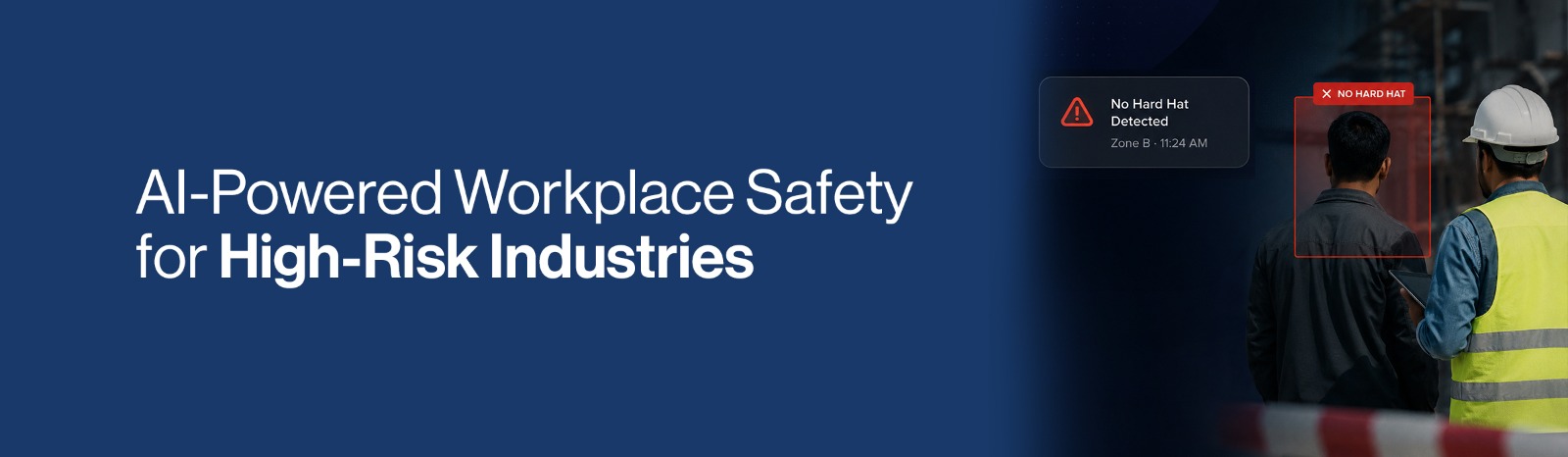
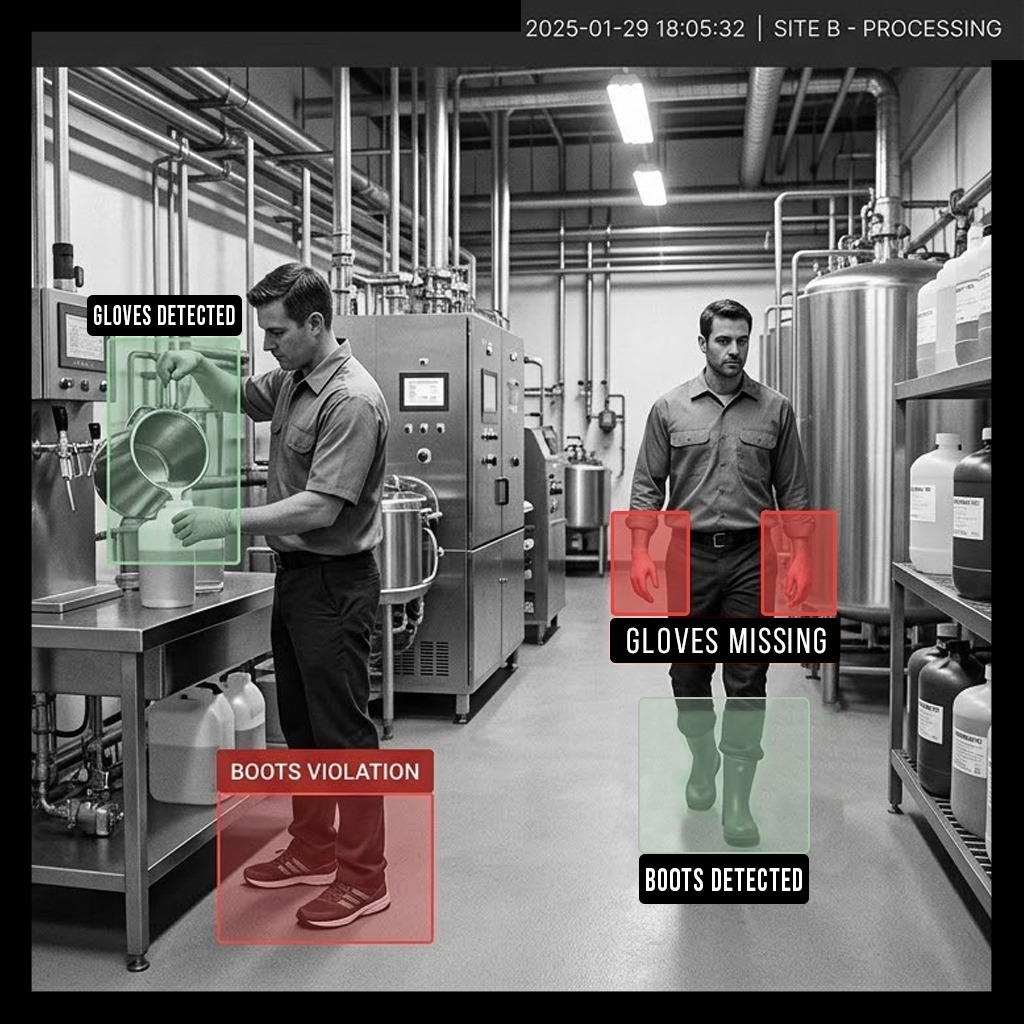
AI hazard detection begins with the most consistent source of preventable risk in industrial environments: non-compliance with personal protective equipment requirements. The Disrupt Labs’ models detect missing or incorrectly worn PPE, classifying each item of protective equipment individually rather than simply confirming the presence of “something.” This enables per-zone enforcement: a chemical handling area requiring respiratory protection, gloves, and full coveralls can be monitored to a different standard than an adjacent logistics corridor requiring only high-visibility vests.
The documented outcomes of this approach to PPE compliance show significantly higher positive outcomes in comparison with what periodic manual inspection delivers at equivalent scale.
Unsafe Behavior Detection
Beyond equipment compliance, The Disrupt Labs’ system monitors behavioral risk: workers entering restricted zones without authorization, personnel stationary in vehicle travel paths, machine guards left open during operation, and workers bypassing established SOP sequences for high-risk tasks. These are the behavioral categories that most frequently precede serious incidents and are hardest to catch through scheduled inspection alone. For a detailed view of how unsafe behavior detection functions in practice, that context covers the specific detection methods and operational impact.
Restricted Area Monitoring
Computer vision AI for restricted zone monitoring defines virtual perimeters within the live video feed. When an unauthorized individual crosses a boundary into a high-voltage zone, chemical storage area, or machinery corridor, an alert reaches the relevant supervisor within seconds. The system logs every entry event with timestamp, zone, and camera reference, generating a continuous access record that supports both operational response and compliance documentation.
Housekeeping and Workplace Safety Monitoring
Blocked emergency exits, standing spills, and obstructed walkways are among the most frequently cited findings in industrial safety audits. They are also among the most preventable if detected early. The Disrupt Labs’ housekeeping compliance monitoring detects these conditions as they develop and deliver alerts before they appear in the next audit report. At Shan Foods, this approach produced a 70% reduction in blocked exit incidents, demonstrating the operational impact of catching these conditions in real time rather than retrospectively.
Forklift and Vehicle Safety Monitoring
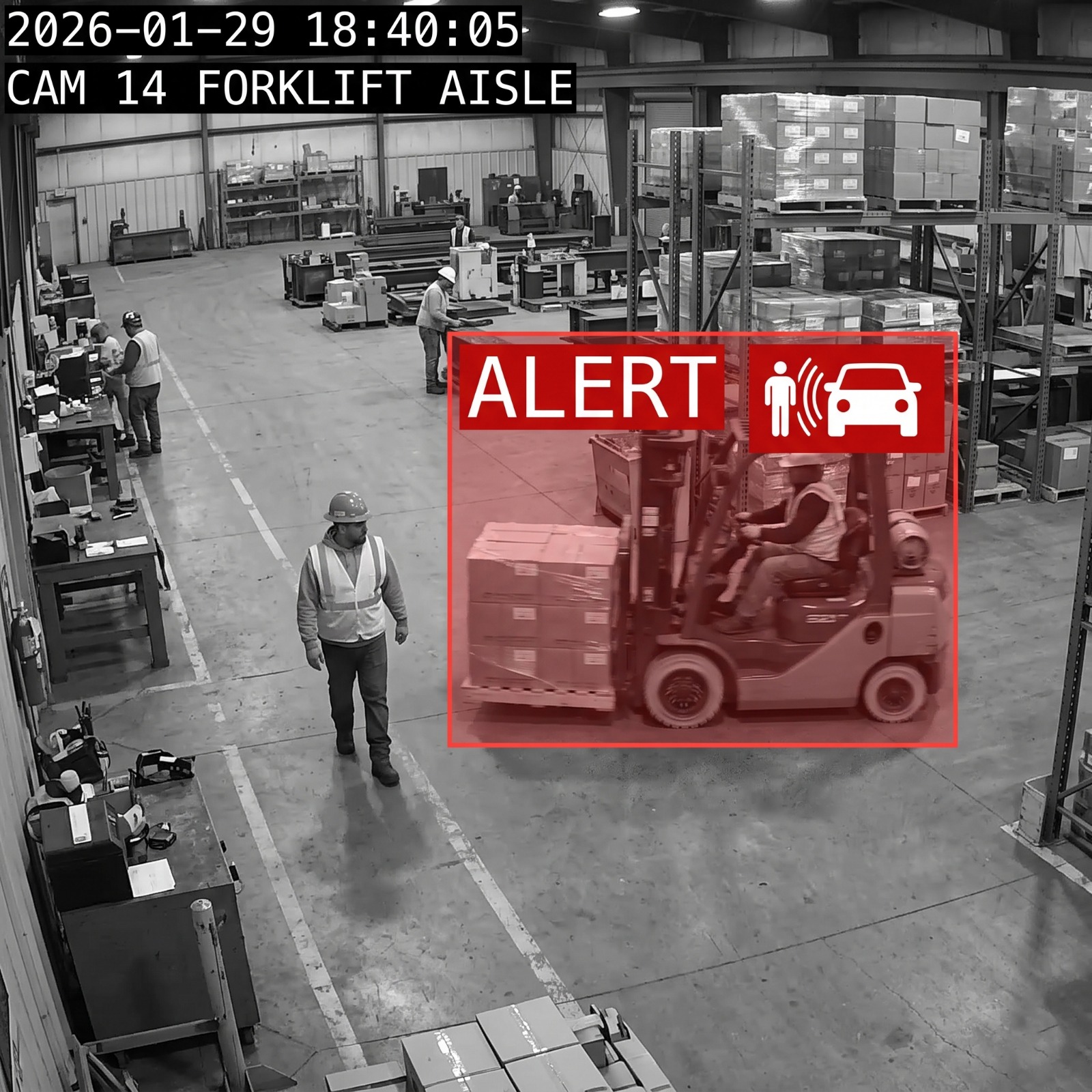
Mixed pedestrian and vehicle environments are among the highest-consequence risk configurations in any industrial facility. The Vision AI safety monitoring system identifies when a safety zone is breached (such as a pedestrian entering an active forklift path) and triggers an immediate alert. The Disrupt Labs’ AI forklift safety monitors and generates alerts before contact is possible. This is how it enables intervention before a collision occurs, effectively neutralizing the threat.
Fire, Smoke, and Emergency Detection
Early detection of fire and smoke conditions is a critical safety application in manufacturing, oil and gas, and chemical processing environments where ignition risks are elevated. Vision AI can be configured to detect visual indicators of fire and smoke in camera feeds and deliver immediate alerts to safety supervisors and emergency response teams. The speed advantage over manual detection is significant in environments where conditions can escalate rapidly.
Automated Audit Reports and Compliance Records
Every detection event is automatically timestamped and logged by zone and violation type. This generates a continuous compliance record that supports EHS compliance reporting without manual documentation overhead. Safety managers can extract violation trends by zone, shift, and workflow type, which informs targeted corrective action rather than generic retraining across the entire facility.
Key Benefits of AI-Powered Workplace Safety
Reduce Workplace Accidents
The most direct benefit of AI for workplace safety is incident prevention at the near-miss stage. Hazards detected and corrected before they produce an incident never generate the downstream costs of regulatory investigation, production shutdown, insurance implications, and workforce disruption.
With the Disrupt Labs, our AI-based solutions turn safety data into actionable insights, enabling safety supervisors to identify recurring hazards, monitor compliance in real time, and proactively address problems before they escalate.
By applying AI across high-risk zones, and operational workflows, industries can enforce consistent safety standards, streamline audits, and drive continuous improvement across all zones, ensuring a safer and fully compliant industrial environment.
Improve EHS Compliance
Consistent, automated enforcement applies the same detection criteria to every worker on every shift, removing the dependency on supervisory presence that creates compliance gaps in manual monitoring. The continuous compliance record generated by the system also satisfies the documentation requirements of formal EHS audits and regulatory reporting without requiring additional manual preparation.
Increase Operational Visibility
Safety managers gain access to leading indicators that manual monitoring cannot produce at scale: near-miss frequency by zone, PPE compliance trends by shift, behavioral patterns that precede incidents, and comparative data across sites and time periods. This is the difference between managing safety reactively based on what has already happened and managing it proactively based on what the data shows is currently developing.
Faster Incident Response
The interval between a hazard developing and the right person being notified is one of the most consequential variables in industrial safety. Workplace safety AI compresses that interval from minutes or hours to seconds. The operational significance is not just speed: it is the difference between an alert that reaches a supervisor while intervention is still possible and a log entry that documents what happened after it was too late to act.
Data-Driven Safety Decisions
The Disrupt Labs’ platform supports root cause analysis at a level that periodic manual inspection cannot. Identifying that a specific zone consistently generates near-miss alerts at particular shift hours points to a region that needs further scrutiny. This systemic insight is only accessible when the underlying data is continuous, comprehensive, and structured.
Industries Benefiting from AI Workplace Safety
Manufacturing
In manufacturing environments, Vision AI addresses PPE compliance, machine guard monitoring, restricted zone access, and SOP adherence simultaneously across production lines. The Disrupt Labs has active deployments across FMCG and food manufacturing, where the combination of high foot traffic, heavy machinery, and continuous production creates a dense and variable risk environment that manual monitoring alone cannot adequately cover.
Warehousing and Logistics
Warehousing and logistics operations face a specific risk profile dominated by mixed pedestrian and vehicle traffic. Forklift-pedestrian proximity, blocked emergency routes, and improper storage of heavy materials are the most consequential compliance categories. AI workplace safety in this environment is primarily about traffic management and housekeeping compliance rather than PPE alone, though both are typically monitored simultaneously.
Construction
Construction sites present a particularly challenging monitoring environment: dynamic site layouts, elevated work zones, heavy machinery, and a constantly changing workforce. AI hazard detection in construction focuses on fall protection compliance, harness detection for elevated workers, restricted area access near active machinery, and near-miss tracking for events that would otherwise go unreported.
Oil and Gas
Oil and gas environments carry some of the highest consequence risk in any industrial sector. The combination of flammable materials, pressurized systems, elevated work zones, and confined space entry requirements means that a single compliance failure can have catastrophic consequences.
Standardized Compliance Monitoring
Human oversight is inherently subjective, varying between shifts and individual supervisors. Vision AI applies uniform, objective criteria across every single observation, ensuring standardized compliance monitoring pharma protocols across all facility shifts and plant locations for effective oversight.
Pharmaceutical Manufacturing
In pharmaceutical manufacturing, safety compliance intersects directly with GMP quality requirements. Workers who do not maintain PPE compliance in sterile or controlled environments simultaneously create a safety risk and a product contamination risk. The Disrupt Labs’ GMP compliance monitoring addresses both dimensions through the same camera infrastructure, providing a single data layer for safety and quality compliance documentation.
Why Choose The Disrupt Labs for AI Workplace Safety?
Vision AI Built for Industrial Environments
Across high-demand industrial corridors in Pakistan, local manufacturing hubs in textiles, pharmaceuticals, and heavy industry operate under intense output pressures where manual supervision naturally stretches thin.
Deploying an intelligent vision layer over existing CCTV networks bypasses the limits of paper walkthroughs. This ensures critical protocols (like mandatory helmets or strict chemical zone clearance) are enforced uniformly across every shift without requiring expensive hardware upgrades. By turning passive video feeds into a 24/7 safety net, regional plants can meet international EHS standards, protect their workers, and prevent costly operational disruptions.
Existing CCTV Integration
Most industrial facilities already have camera infrastructure in place. The Disrupt Labs’ platform integrates with existing IP camera feeds as a software layer, meaning the transition to continuous monitoring does not require a facility-wide hardware replacement. This significantly reduces the implementation cost and timeline, making the business case easier to justify when the incremental investment is software and configuration rather than a new camera network.
Centralized Dashboard and Real-Time Alerts
The Disrupt Labs’ centralized dashboard and SafetyLens mobile application deliver detection data to safety managers in real time, regardless of location. Every alert includes zone, timestamp, and violation type, giving supervisors the specific information they need to respond rather than a generic notification. The same data feeds into compliance reporting and trend analysis, making the dashboard both an operational tool and a management information resource.
Scalable AI Solutions for Enterprise Operations
For organizations operating across multiple sites, the platform provides a consistent monitoring standard regardless of site-specific differences in layout, workforce, or production process. Cross-site compliance benchmarking, pattern analysis, and centralized reporting all become possible when every facility generates data in the same format. This scalability is what makes Vision AI a strategic investment for enterprise operations rather than a single-site tool.
Future of AI in Workplace Safety
Predictive Safety Analytics
The near-term development trajectory for AI for workplace safety is from detection to prediction. As The Disrupt Labs’ systems accumulate facility-specific data, the analytical layer above individual alerts becomes capable of identifying structural conditions that consistently precede incidents: zones generating near-miss events at specific shift hours, workflows correlated with elevated violation rates, staffing patterns linked to compliance drift. Acting on these patterns at the systemic level is what moves a facility from reactive incident management to genuinely predictive risk prevention.
AI-Driven EHS Compliance
The convergence of real-time AI monitoring with formal EHS management systems is creating a new operational model for compliance documentation. Rather than periodic manual compilation of audit records, facilities can generate continuous, objective compliance data available for regulatory review at any time without additional preparation. Facilities with this infrastructure in place will be better positioned as regulatory frameworks evolve to reflect what continuous monitoring makes technically achievable.
The Future of Vision AI Monitoring
Looking further ahead, Vision AI is evolving to understand the deeper context of safety on the floor. Instead of simply checking if a hard hat or a piece of safety gear is present in a frame, tomorrow’s systems will verify whether it is fitted correctly and matches the specific risks of that exact work zone
More importantly, this technology will plug directly into broader factory data and shift management systems. By linking everyday safety slip-ups with operational pressures making the safety dataset genuinely predictive rather than simply descriptive. Eventually this will help safety teams fix the root causes before trouble ever starts.
Conclusion
AI for workplace safety is not a future consideration for high-risk industries. It is a production-ready technology delivering documented, measurable outcomes across manufacturing, warehousing, oil and gas, pharmaceutical, and logistics environments. The Disrupt Labs converts existing camera infrastructure into a real-time safety intelligence platform without hardware replacement, with a continuous compliance record, and with alert response times measured in seconds rather than hours.
The gap between having cameras and having a safety intelligence platform is the gap between recording incidents and preventing them. The Disrupt Labs closes that gap.
Contact The Disrupt Labs to discuss how AI for workplace safety can strengthen protection in your facility.
Frequently Asked Questions
AI for workplace safety uses computer vision and existing CCTV cameras to monitor industrial environments in real time, automatically detecting hazards and compliance violations.
It works by analyzing video feeds frame-by-frame to instantly catch risks like missing PPE or unauthorized zone entries, shifting safety from manual checks to proactive prevention.
Missing hard hats, safety vests, gloves, boots, masks, or other PPE, Slip, Trip, and Fall Risks, Restricted Zone Breaches, Forklift and Vehicle Hazards, Blocked emergency exits, and other Unsafe Behaviors.
Vision AI based workplace safety fundamentally transforms monitoring by replacing the inherent limitations of human oversight with real-time, automated intelligence.

وفاء زهرة
She brings together her expertise in business development and content strategy to showcase the growing role of computer vision AI in enhancing workplace safety and HSE/EHS compliance. At The Disrupt Labs, she focuses on writing insightful content that explores AI-driven innovations and their impact on industrial safety.
View all posts