Computer Vision Workplace Safety: AI-Powered Monitoring Systems for Industrial Safety
In the high-stakes environment of heavy industry, safety is often treated as a series of retrospective reports. We analyze what went wrong, fill out the paperwork, and hope the next shift is luckier. But hope is not a management strategy. Despite decades of rigorous protocols, the human and financial costs of workplace incidents remain a critical burden. To move toward a zero-harm environment, facilities must adopt computer vision workplace safety protocols that act before a hazard becomes a headline.
According to the National Safety Council (NSC), the total cost of work injuries in 2022 was $167 billion – a staggering figure that highlights the limitations of manual oversight. Traditional safety measures rely on periodic audits and human vigilance, both of which are subject to fatigue and “blind spots.”
What Is Computer Vision in Workplace Safety?
Definition and How It Works
At its core, computer vision is a field of artificial intelligence that enables computers to “see” and interpret visual data from the world. In the context of computer vision workplace safety, this means transforming standard CCTV cameras into intelligent observers. The system uses advanced algorithms to identify objects, track movements, and recognize specific patterns that indicate danger. Instead of just recording footage for later review, the technology analyzes every frame in milliseconds to detect anomalies.
Role in Industrial Safety Monitoring
The primary role of these systems is to provide a 24/7 digital auditor for the facility. Unlike a human supervisor who can only be in one place at a time, workplace safety monitoring systems can cover every square foot of a warehouse or production line simultaneously. By integrating computer vision workplace safety software, companies can ensure that safety standards are maintained consistently across all shifts, including high-risk night operations where human supervision is often thinned.
How Computer Vision Improves Workplace Safety
Detecting Unsafe Behavior in Real Time
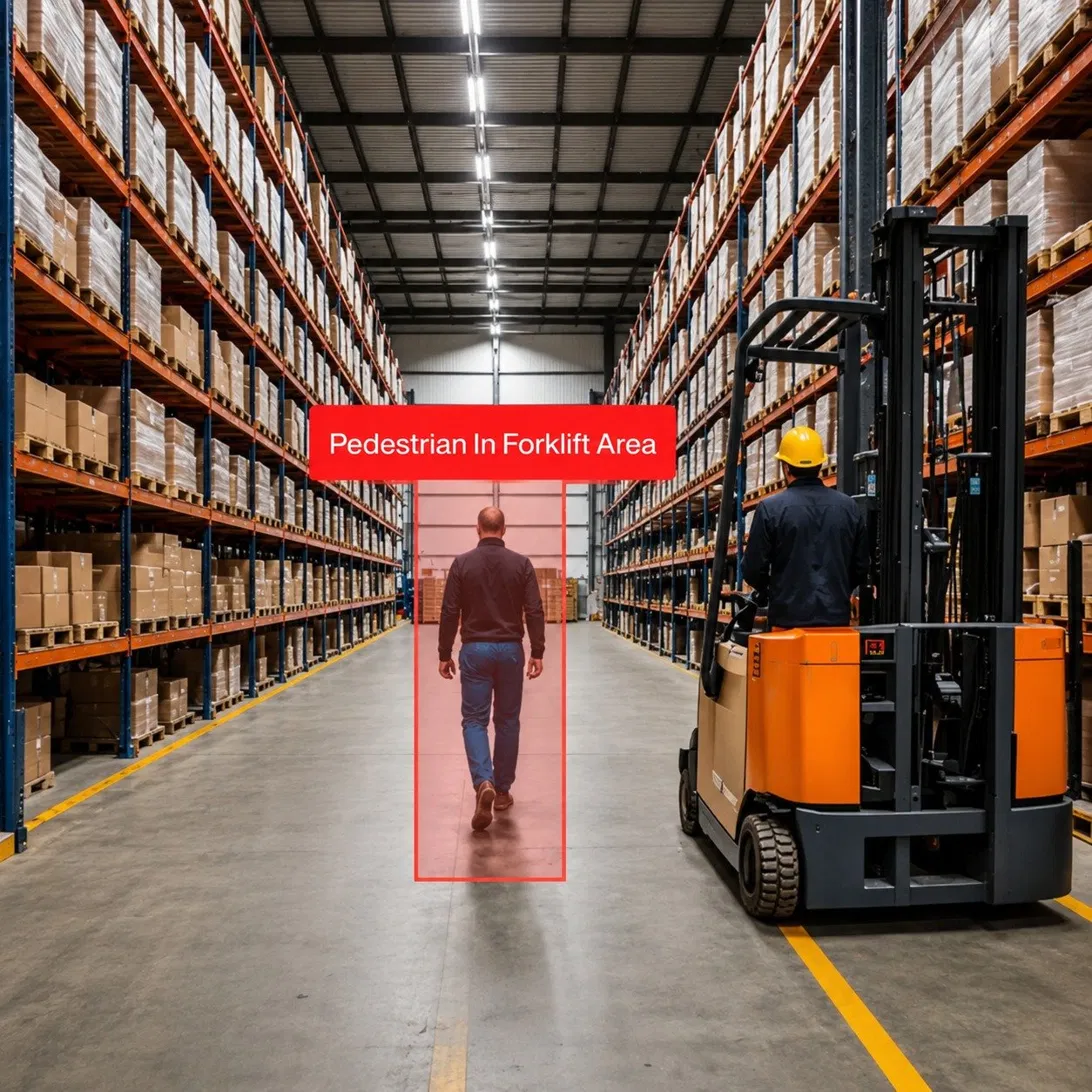
Human error remains the leading cause of industrial accidents. Whether it’s a worker taking a shortcut through a forklift lane or someone stepping into a restricted industrial zone without proper care, these split-second decisions lead to disaster. Real-time hazard detection identifies these behavioral risks as they happen, triggering immediate floor alerts and allowing for intervention before the “near-miss” turns into an injury.
Monitoring Industrial Hazards Automatically
Environmental hazards like oil spills, blocked emergency exits, or trailing cables are often “invisible” until someone trips over them. These AI based safety systems are trained to recognize these environmental precursors. When the AI detects a liquid pattern on the floor or a pallet obstructing a pedestrian walkway, it flags the hazard on a central dashboard, ensuring the maintenance team can resolve the issue immediately.
PPE Compliance and Safety Enforcement
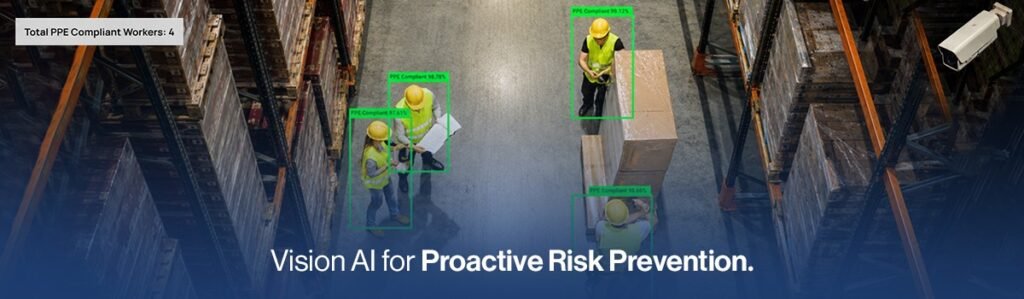
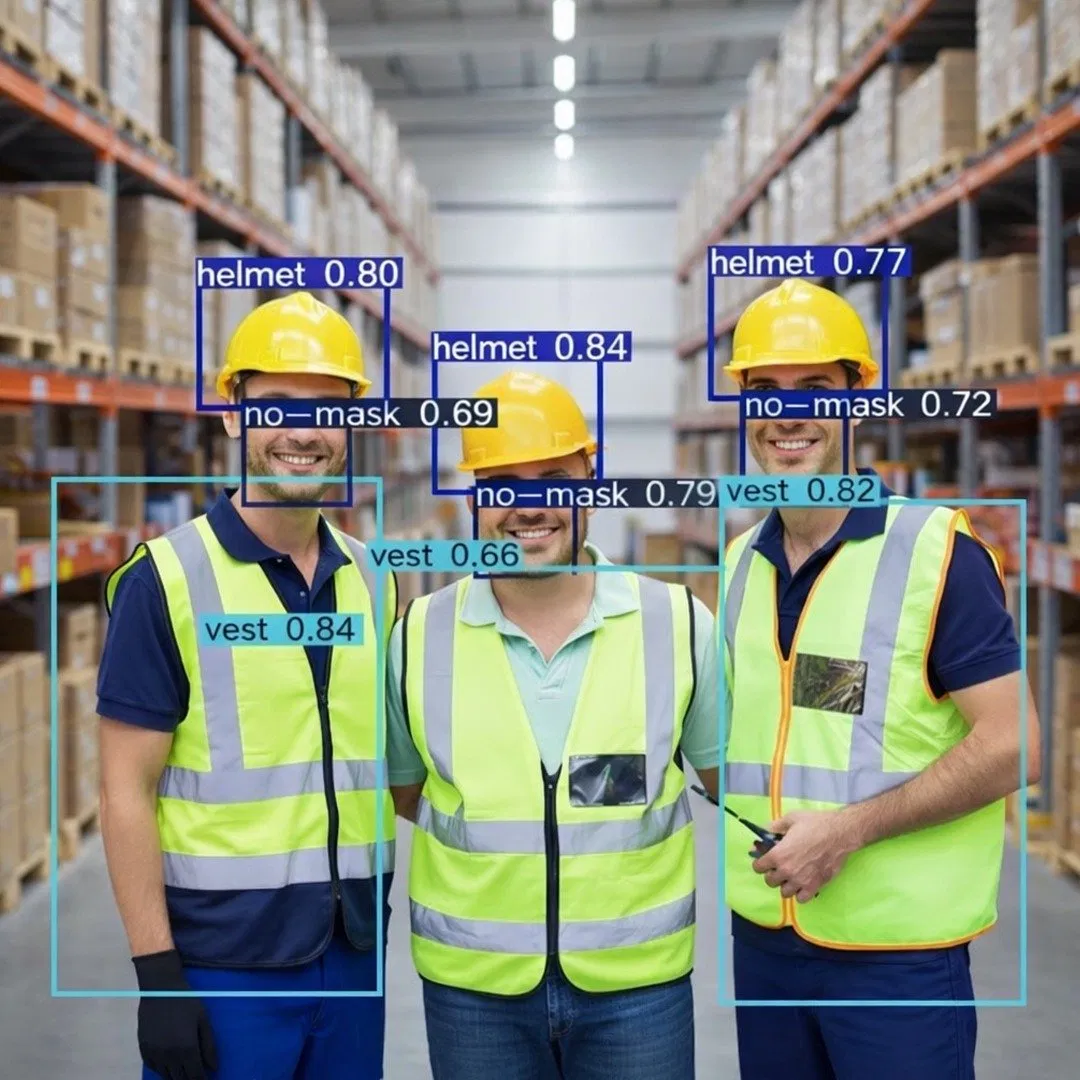
Ensuring 100% adherence to Personal Protective Equipment (PPE) standards is an administrative headache for EHS managers. Vision AI solutions for PPE compliance technology automates this process by scanning workers for hard hats, high-visibility vests, and protective eyewear at entry points and throughout the facility. If a violation is detected, the system logs the event and notifies the supervisor, shifting the burden from manual checking to automated enforcement.
What Are AI Safety Monitoring Systems?
How AI and Computer Vision Work Together
While computer vision workplace safety software provides the “eyes,” AI provides the “brain.” These two components work together to form smart safety systems that do more than just see – they understand context. For example, a camera might see a person and a forklift; the AI understands the proximity between them and determines if they are on a collision course based on speed and trajectory.
Real-Time Data Collection and Alerts
The true value of these systems lies in their ability to process massive amounts of visual data and distill it into actionable alerts. Every detected hazard or “near-miss” is logged as a data point. This constant stream of information allows computer vision workplace safety platforms to generate heatmaps of high-risk areas, helping management identify where structural changes are needed to prevent future accidents.
Industrial Applications of Computer Vision Safety Systems
Industrial computer vision applications transform reactive incident reporting to proactive hazard recognition. These applications eliminate the gaps caused by human fatigue in high-stakes environments like manufacturing and construction. Ultimately, this integration ensures that safety compliance is a constant state rather than a periodic event, directly reducing workplace accidents while protecting operational continuity.
Manufacturing Plants
In manufacturing, the focus is on machine guarding and zone control. Vision systems monitor restricted zones around industrial work zones and high-speed machinery, instantly halting operations if a worker enters a dangerous area.
Construction Sites
Construction environments are dynamic and chaotic. Computer vision workplace safety assists by monitoring fall-arrest equipment usage on scaffolding and ensuring that heavy machinery operators are aware of ground personnel in their blind spots.
Oil and Gas Industry
In the oil and gas sector, these systems are deployed to monitor for leaks, ensure spark-free zones are maintained, and manage site access in remote, high-risk locations where manual supervision is impossible.
Benefits of AI-Powered Safety Monitoring Systems
Reduced Workplace Accidents
By moving from reactive reporting to proactive intervention, industrial safety technology allows you to neutralize threats before they manifest. When a system can detect a slip hazard or a forklift proximity risk in milliseconds, the “accident chain” is broken before the point of impact. This is the power of AI based CCTV: real-time dashboard alerts on a central dashboard which leads to optimized EHS compliance.
Faster Emergency Response
In the event of an incident, seconds matter. The Disrupt Labs’ platform provides real-time alerts to emergency response teams, including the exact coordinates and visual context of the event. This eliminates the “information lag” that often occurs during a crisis.
Continuous Safety Compliance
Compliance is no longer a periodic event geared toward passing an audit. With The Disrupt Labs, safety becomes a constant state. The software provides a digital audit trail of every hazard detected and resolved, proving to regulators and insurers that your facility maintains a proactive commitment to worker safety 24/7.
Future of Computer Vision in Industrial Safety
Predictive AI Safety Systems
We are entering the era of predictive safety. Future computer vision workplace safety models will not just see current hazards; they will forecast them. By analyzing employee work patterns and equipment protocols, the AI will predict where a bottleneck or a spill is likely to occur, allowing for preemptive maintenance.
Integration with Industry 4.0
The integration of computer vision with the broader Industry 4.0 ecosystem means that safety will be hard-coded into production. Digital twins will simulate safety scenarios, and AI will automatically adjust production speeds based on the real-time density of workers on the floor, ensuring that productivity and safety are never in competition.
Conclusion
The shift toward automated awareness is not just a technological upgrade; it is a cultural revolution. By choosing معامل الاضطراب, organizations are moving away from the era of “fingers crossed” safety and into the era of data-driven certainty.
As industry leaders know, a safer site is a more profitable site. The Disrupt Labs Vision AI solutions automate the enforcement of over 30+ EHS (Environment, Health, and Safety) rules.
Embracing computer vision workplace safety is the final step in building a resilient, future-proof organization where every worker returns home safe, every single day.
Take the first step towards aligning your business with new industry standards; schedule an appointment with us today!
Frequently Asked Questions
Yes, computer vision systems can automatically detect PPE compliance by identifying whether workers are wearing safety helmets, gloves, vests, goggles, and other required protective equipment in real time.
Industries such as manufacturing, construction, oil and gas, warehousing, logistics, and heavy industrial operations benefit significantly from AI-powered safety monitoring systems due to their high-risk environments.
Computer vision workplace safety solutions help reduce workplace accidents, improve emergency response times, automate EHS compliance, minimize human error, and create safer industrial operations through real-time hazard detection.
Yes, AI safety monitoring systems help reduce workplace accidents by identifying hazards, unsafe actions, and environmental risks in real time, allowing immediate intervention before incidents occur.
Real-time hazard detection is important because it enables organizations to respond instantly to unsafe situations, preventing injuries, reducing downtime, and improving overall workplace safety compliance.

وفاء زهرة
She brings together her expertise in business development and content strategy to showcase the growing role of computer vision AI in enhancing workplace safety and HSE/EHS compliance. At The Disrupt Labs, she focuses on writing insightful content that explores AI-driven innovations and their impact on industrial safety.
View all posts