What Is PPE Detection? A Complete Guide to AI-Powered Workplace Safety
Personal protective equipment is the last line of defence between a worker and a serious injury. When it is missing, incorrectly worn, or gradually abandoned as a shift progresses, that defence fails silently. Asking what is PPE detection, and how The Disrupt Labs is automating it, is increasingly central to how industrial facilities manage safety compliance in 2026.
What Is PPE Detection and How Does It Work?
What is PPE detection in practical terms? It is the automated identification of whether workers are wearing required protective equipment, in real time.
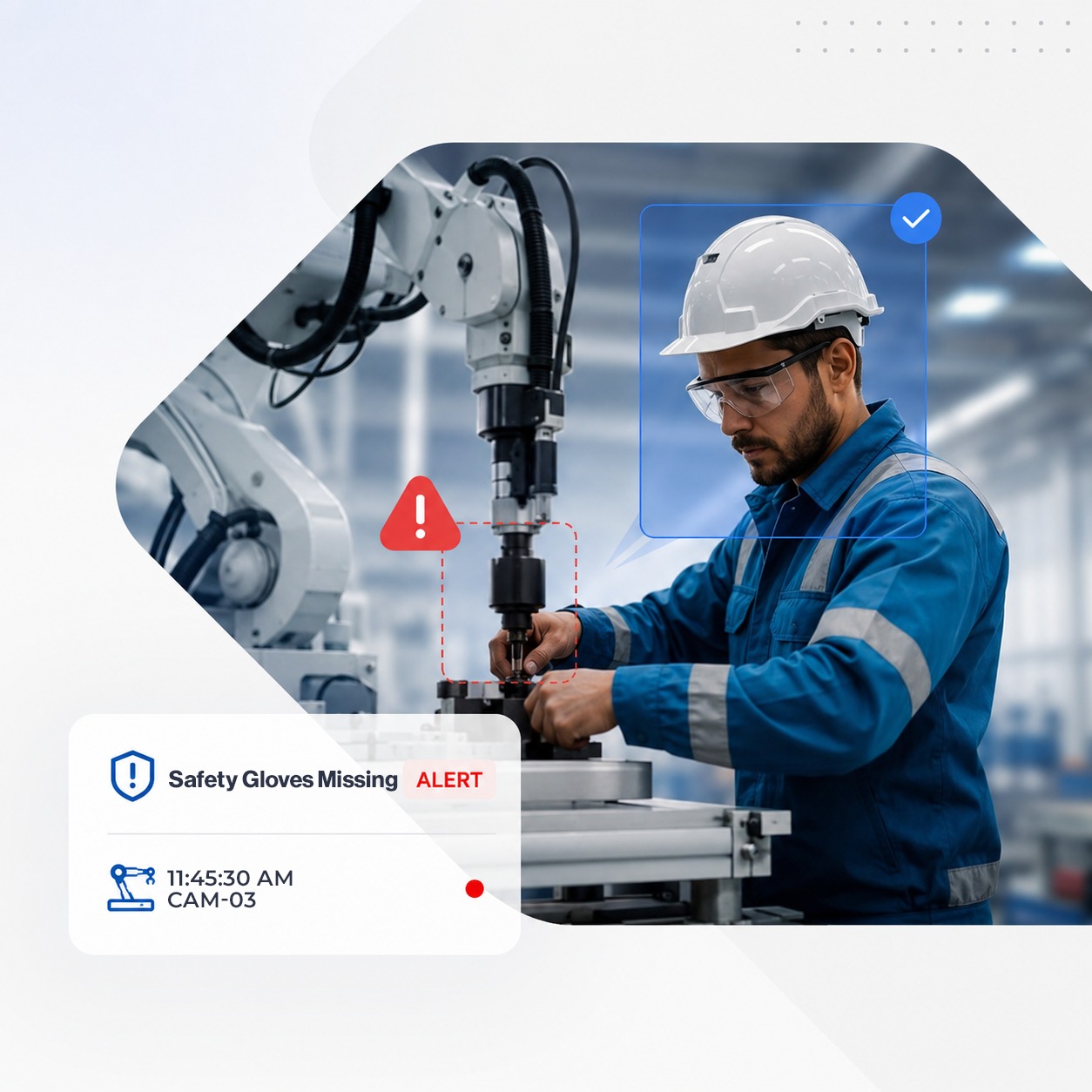
Rather than relying on a supervisor to spot a missing hard hat during a walkthrough, the AI powered CCTV monitors every worker in every monitored zone, continuously, and generates an alert the moment a violation is detected.
Why PPE Detection Is Important for Workplace Safety
Workers without proper PPE are significantly more likely to sustain injuries than those with correctly fitted protective gear.
The consequences extend beyond the individual: incidents generate regulatory investigations, production downtime, and insurance implications. Manual PPE checks are too slow and inconsistent to catch the gradual compliance drift that occurs across long shifts, in low-supervision areas, and during off-peak hours.
Automated detection addresses these gaps directly. Most EHS penalties are costly and retroactive, meaning you only find out a rule was broken after an injury. AI-powered systems stop accidents before they happen by correcting bad habits right away.
Types of Personal Protective Equipment That Can Be Detected
Modern detection platforms can identify a wide range of protective gear: hard hats and safety helmets, high-visibility vests, safety gloves, protective footwear, face masks, safety goggles, ear protection, etc. The Disrupt Labs’ safety models detect different kinds of PPE which is what makes them operationally useful rather than just technically present.
How Automated PPE Systems Improve Safety Compliance
The compliance improvement from automated detection comes from consistency. A human observer enforces standards when present and attentive.
Continuous monitoring applies the same standard to every worker on every shift, regardless of time of day or supervisory presence. They use AI-powered software to spot missing gear (like hard hats or safety vests), instantly notify workers, and log data for audits.
What Is a PPE Detection System?
To fully answer what is PPE detection, it helps to understand what the system itself consists of. This is a software layer applied to existing CCTV infrastructure that uses trained computer vision models to monitor compliance continuously. It does not require new cameras in most deployments.
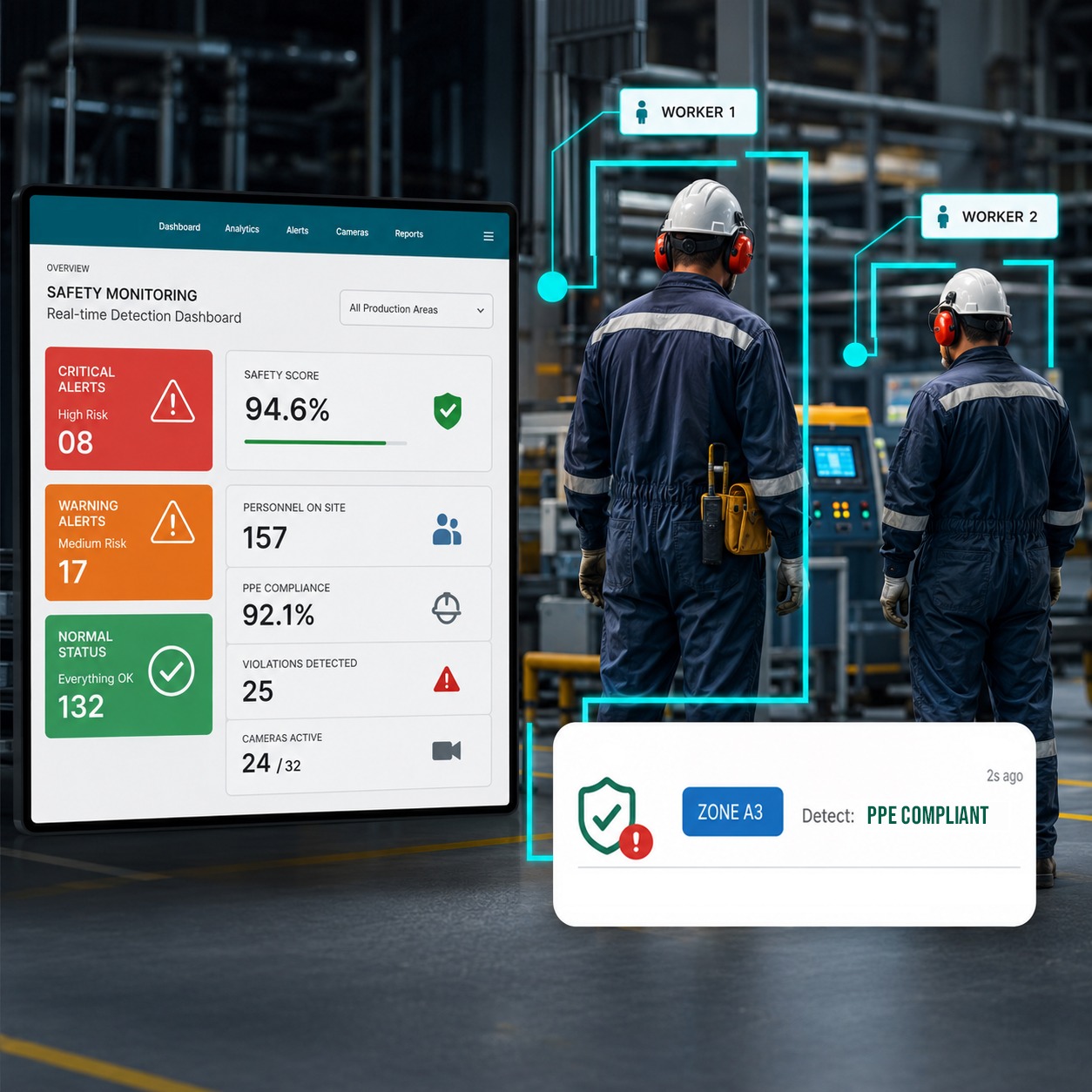
The Disrupt Labs’ Vision AI solution is trained to detect PPE from live CCTV feeds, instantly sending alerts for non-compliance. Ultimately, the intelligent computer vision AI helps safety managers improve workplace safety. When a violation is identified, an alert reaches the supervisor through a centralized dashboard or mobile application, with every event logged and timestamped for PPE compliance documentation.
How Computer Vision PPE Detection Works
The question of what is PPE detection becomes most concrete at the technical level: computer vision models processing live video, classifying protective equipment, and triggering alerts. Here is how each layer operates.
Real-Time Video Monitoring
AI-Powered PPE detection works by processing live video feeds frame by frame, identifying their protective equipment. The Disrupt Labs’ smart CCTV software is tailored to your industrial layout, to help businesses move from manual and time-consuming safety enforcement to real-time compliance detection and immediate alerts.
AI-Powered Safety Alerts
When the system identifies a violation, an alert is delivered immediately to the relevant safety supervisor through The Disrupt Labs’ centralized dashboard and SafetyLens mobile application, shortening the response window from minutes to seconds.
Compliance Reporting and Analytics
Every detection event is automatically timestamped and logged, generating a continuous compliance record without manual overhead. Safety managers gain access to violation trends by zone, shift, and workflow type, informing targeted corrective action. For EHS compliance reporting requirements, this automated record is a material operational advantage.
Benefits of AI PPE Detection Solutions
These solutions deliver measurable outcomes across several operational dimensions. Compliance rates improve because enforcement is consistent and continuous rather than dependent on supervisory presence.
Incident rates decline because violations are caught before they result in injury. Manual monitoring workload decreases because most serious accidents are preceded by unrecorded near-misses (e.g., a forklift stopping inches from a pedestrian). The Disrupt Labs’ Vision AI flags speed anomalies, forklift-to-worker proximity, and blocked walkways instantly to catch these patterns
Proving your workplace is safe usually means a lot of paperwork. Vision AI makes this process digital, fast, and easy. With Vision AI, reporting gaps are eliminated, documentation is audit-ready, and in high-risk sectors, it can be helpful when there is a record log for all of the work being done. Vision AI eliminates this friction by logging every single unsafe event and PPE violation automatically, standardizing worker safety.
Industries That Use PPE Detection Systems
Vision AI solutions are deployed across manufacturing, oil and gas, pharmaceutical production, warehousing and logistics, food and beverage, and construction. The Disrupt Labs has active deployments in FMCG manufacturing (Unilever), oil refining and petrochemicals (Axens Arabia), and food manufacturing (Shan Foods).
Each sector has distinct PPE requirements, which is why the detection models need to be configured for the specific gear relevant to each environment. This is the advantage with The Disrupt Labs: a tailored-to-fit industrial safety solution.
In pharmaceutical manufacturing, PPE detection intersects directly with GMP compliance: gloves, masks, and protective clothing are regulatory requirements.
In oil and gas, flame-resistant clothing and harness compliance carry the highest consequence if missed.
In warehousing, high-visibility vests and protective footwear are the primary categories, particularly in zones shared with forklifts.
Challenges and Limitations of AI PPE Detection
AI PPE detection has transformed workplace safety by making safety compliance monitoring faster, more consistent, and proactive. However, like any safety solution, its effectiveness depends on proper implementation. Clear camera coverage, well-defined safety policies, and employee awareness all contribute to achieving the best results. Rather than replacing safety teams, AI strengthens their ability to identify PPE violations in real time, improve compliance, and maintain a safer working environment.
Future Trends in AI and Computer Vision for Workplace Safety
The future of AI and computer vision in workplace safety is moving beyond detecting PPE violations to predicting and preventing risks before they occur. As Vision AI continues to evolve, organizations will benefit from smarter hazard detection, predictive safety insights, automated compliance reporting, and real-time safety intelligence across entire facilities.
AI-powered CCTV systems will play an increasingly important role in helping safety teams improve operational visibility, reduce workplace incidents, and maintain continuous compliance with EHS standards. By combining intelligent monitoring with data-driven decision-making, businesses can build safer, more efficient, and future-ready industrial workplaces.
Conclusion
PPE detection has moved from a manual, spot-check process to a continuous, automated layer of workplace safety. By running on existing CCTV infrastructure, it closes the gap that human monitoring cannot: catching violations consistently, across every shift and every zone, without relying on supervisor presence.
As facilities across manufacturing, oil and gas, and logistics adopt this technology, the focus is shifting from simply detecting violations to preventing them, using real-time alerts and compliance data to correct unsafe behaviour before it results in injury. For industrial sites where downtime, regulatory risk, and worker safety are all on the line, this shift matters.
The Disrupt Labs’ Vision AI platform brings this capability to facilities using their current camera systems, with detection models configured for sector-specific PPE requirements. To see how it applies to your operations, get in touch with our team.
Frequently Asked Questions
AI PPE detection uses computer vision AI to automatically identify whether workers are wearing required personal protective equipment (PPE), such as helmets, safety vests, gloves, goggles, and safety shoes, through existing CCTV cameras.
AI-powered PPE detection can identify a wide range of safety equipment, including hard hats, reflective vests, safety goggles, face masks, gloves, safety shoes, and other PPE based on your workplace requirements.
AI continuously monitors work areas, detects PPE violations in real time, and sends instant alerts to safety teams. This enables faster corrective action, improves compliance with safety regulations, and helps reduce workplace accidents.
Yes. By identifying PPE non-compliance in real time, AI enables organizations to address unsafe behaviors before they lead to incidents, helping reduce workplace injuries and operational risks.
Yes. AI PPE detection can be tailored to industry-specific safety requirements for manufacturing, construction, oil and gas, logistics, warehouses, and other industrial environments.

Wafa Zehra
She brings together her expertise in business development and content strategy to showcase the growing role of computer vision AI in enhancing workplace safety and HSE/EHS compliance. At The Disrupt Labs, she focuses on writing insightful content that explores AI-driven innovations and their impact on industrial safety.
View all posts